Burnout Productivity Costs: 47% Output Loss & Solutions
Productivity Costs of Burnout
How Work Overload Destroys Output and Quality
Work overload does not just make employees tired, it creates a vicious cycle that devastates organizational productivity. Exhausted employees produce less, make more mistakes, and require more support from colleagues who are already stretched thin. This article examines how workplace burnout transforms productive teams into struggling operations, and how one leader reversed the spiral.
Work Overload: The Primary Driver
Rotenstein et al. (2023) found that high work demands lead to a 30% increase in burnout symptoms. When employees face unrealistic workloads with insufficient resources, burnout becomes inevitable. The cascading effect is predictable:
1. Work overload causes burnout
2. Burnout reduces productivity
3. Reduced productivity increases work overload for remaining staff
4. The cycle accelerates until the system collapses
Symptoms of Burnout: The Operational Impact
Two different research studies, one by Rotenstein et al. (2023) and one by Izdebski et al. (2023) reveal significant increases in burnout symptoms across healthcare roles.

Work Overload
Work overload showed dramatic increases across all professional categories. Employees report feeling perpetually behind, unable to complete tasks despite working extended hours. The gap between work demands and available resources continues to widen.
Exhaustion
Physical and emotional exhaustion affects every aspect of performance. Employees arrive at work already depleted, lacking energy reserves needed for complex problem-solving or sustained focus.
Mental Distance
Employees emotionally detach from their work, viewing it as tasks to endure rather than meaningful contributions. They are physically present but mentally checked out.
Emotional Impairment
Emotional exhaustion and empathy fatigue make it difficult to connect authentically with customers or colleagues. Irritability and short tempers become common.
Cognitive Impairment
Poor concentration, memory lapses, and difficulty making decisions plague burned out employees. Tasks requiring analytical thinking become overwhelming.
Measurable Losses
Work Redistribution Crisis
Abt Associates (2020) found that 58% of work is reassigned to remaining colleagues when employees take leave. This creates a cascading crisis that accelerates burnout across entire teams. This study quantified work overload:
• Clinical staff: 47.4%
• Nurses: 46.9%
• Non-clinical staff: 44.5%
• Physicians: 37.1%
These are not minor efficiency losses, organizational capacity is being cut nearly in half. Imagine paying 100% of salary for 50% of output. That is the reality of burnout's productivity impact due to increased work loads.
Decreased Output: The Visible Crisis
Extended Wait Times
Organizations report 3-6 month wait times for service. This is not due to increased demand alone, burned out employees serve fewer customers, complete fewer projects, and deliver slower results.
Gaps in Service Delivery
Staffing shortages combined with rising demand create significant gaps. Essential tasks go undone, quality deteriorates, and customers experience frustration.
Increased Errors: The Quality Crisis
Burned out employees make more mistakes. The symptoms driving errors are:
• Emotional exhaustion: Depleted mental energy means less attention to detail
• Empathy fatigue: Reduced emotional connection leads to less careful work
• Overwhelm: Cognitive overload prevents thorough checking
• Poor concentration: Difficulty maintaining focus increases oversight
• Low motivation: Lack of engagement means cutting corners
• Role ambiguity: Confusion creates gaps and duplicated efforts
Case Study: Joy's Productivity Revolution
When I met Joy, she was concerned that employee productivity was declining. The more employees out of work meant more work for others. She knew this was leading to employee burnout and turnover. Joy was at her wit's end, uncertain how to support those she supervised in a way that would improve productivity and ensure the company met their goals.
The Challenge: The Vicious Cycle of Burnout and Declining Output
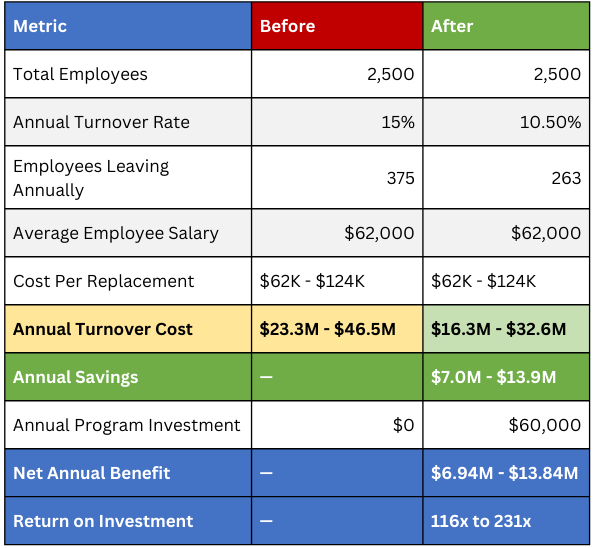
Joy's organization had 2,500 employees and was experiencing a devastating cycle: burnout led to absences and turnover, which increased workload on remaining employees, causing more burnout. With a 15% annual turnover rate driven by employee exhaustion, the financial costs and loss of productivity were staggering.
Understanding the True Cost of Burnout-Driven Turnover
The $23.3M to $46.5M annual cost represents far more than just posting job ads. When an organization loses 375 employees per year to burnout, the financial impact ripples through every aspect of operations:
Direct Recruiting Costs: Industry research shows the hard costs of hiring average $4,700 per employee. For 375 departures annually, that's $1,762,500 spent on job advertising, recruiter fees, applicant tracking systems, background checks, drug screenings, and interview time.
Lost Productivity During Vacancies: With an average vacancy period of 3-4 months per departure, the organization experiences 937-1,250 months of lost productivity annually. During this time, productivity drops 50-100% for those roles.
Decreased Output from Overloaded Employees: Overloaded employees operate at only 60-70% of normal capacity. With 375 vacancies creating ripple effects, hundreds of employees are working at diminished capacity at any given time.
New Employee Ramp-Up Time: It takes 6-12 months for new employees to reach full productivity. During this period, they operate at 25-75% capacity while consuming significant training resources.
Training Time from Current Employees: Experienced employees spend 20-30% of their time training new hires during onboarding. With 375 new employees per year, productive veterans are perpetually diverted from their primary responsibilities.
Increased Errors and Quality Issues: Error rates increase 30-50% among burned-out workers, leading to rework, customer dissatisfaction, and warranty claims. The cumulative cost can run into millions annually.
Understanding the Root Causes
While talking with Joy, I discovered that her top constraint was decreased output and increased errors due to employees being overloaded and exhausted. The data on burnout painted an alarming picture:
• 52% of all employees reported feeling burned out in 2024, with projections showing this will rise to 82% in 2025
• Burned out employees are 3 times more likely to actively seek a new job
• Primary causes: mental and emotional stress (63%), long hours (54%), excessive workload (47%), inadequate compensation (42%), chronic understaffing (37%), and poor leadership (40%)
• Employees experiencing burnout are 59% more likely to start job searching immediately,
In an organization of 2,500 employees with 52% experiencing burnout, that meant 1,300 people were at risk. The vicious cycle was clear: burnout drove turnover, which increased workload on remaining staff, which caused more burnout.
The Solution: Breaking the Cycle Through Strategic Investment
Joy almost didn't reach out to me because she wasn't sure anyone could help. I offered simple solutions focused on addressing the root causes of workplace burnout and productivity decline:
1. Increased Efficiency: Streamline workflows, eliminate redundant processes, and invest in automation.
2. Improved Focus and Mental Clarity: Implement comprehensive mental health support, encourage regular breaks, create quiet spaces for focused work, and actively reduce unnecessary distractions.
3. Time Management Stabilization: Provide training on prioritization, establish realistic deadlines based on actual capacity, and protect employees from constant context-switching.
4. Understanding Unique Personality Types: Use assessments to help employees work in ways that align with their natural strengths and communication styles.
5. Assessments for Insight: Regularly measure employee burnout and stress levels through anonymous surveys and check-ins.
6. Mapping Individual Wellness Needs: Provide flexible benefits and support options so each person can access what works best for them.
Success: Transformation at Scale
Joy invested $60,000 annually in a comprehensive productivity and wellness program. She implemented the plan and the results were transformative:
Immediate Financial Impact: By reducing turnover by 30%, Joy saved $7.0M-$13.9M annually, a return of 116-231 times the $60,000 investment.
Operational Stability: With 112 fewer departures per year, the chaos diminished. Shifts were reliably staffed and Joy could finally focus on strategic work.
Massive Productivity Recovery: The organization recovered thousands of hours previously lost to vacancies, training, and ramp-up periods.
Dramatic Error Reduction: Less-stressed employees made 30-40% fewer errors, saving millions in rework and customer retention.
Sustainable Output Increase: Employees at sustainable workloads showed 20-30% higher output compared to their burned-out baseline.
Breaking the Vicious Cycle: The death spiral reversed into a virtuous cycle of retention and productivity.
Now Joy feels hopeful and encouraged because her team is reliable and efficient.
The Key Takeaway
The $60,000 investment delivered returns that most CEOs only dream of: $7.0M-$13.9M in total annual savings, 112 additional experienced employees retained every year, 30-40% reduction in costly errors, and 20-30% productivity increase across the workforce.
Productivity isn't about working harder, it's about creating conditions where people can work sustainably. When organizations invest in preventing burnout, they unlock the full potential of their workforce.
There is Hope
Abundant Wellness Essentials transforms workplace burnout through holistic solutions that boost productivity, improve efficiency, and strengthen team performance. When employees feel valued and supported, output increases, errors decrease, and quality improves, creating the high-performing culture your organization deserves. Don't let burnout continue limiting your potential.
Ready to boost your team's productivity? Book a consultation at abundantwellnessessentials.com/consult
Next in This Series
In our final article, "The Retention and Performance Crisis," we examine FMLA utilization patterns, intent-to-leave statistics, and turnover drivers. You will discover Sally's transformation from constant crisis management to leading a reliable, engaged team.
References
Abt Associates. (2020, July). Employee and worksite perspectives of The family and medical leave act: Results from The 2018 surveys.
Izdebski, Z., Kozakiewicz, A., Biatorudzki, M., Dec-Pietrowska, J., & Mazur, J. (2023). Occupational burnout in healthcare workers, stress and other symptoms of work overload during the COVID-19 pandemic in Poland. National Library of Medicine.
Rotenstein, L. S., Brown, R., Sinsky, C., & Linzer, M. (2023). The association of work overload with burnout and intent to leave the job across the healthcare workforce During COVID-19. National Library of Medicine.