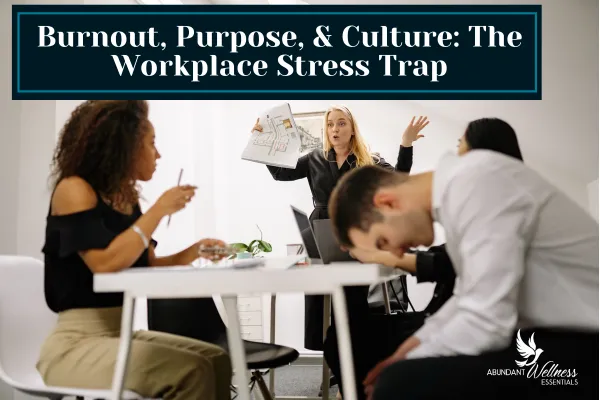
Burnout, Purpose & Culture: The Workplace Stress Trap
Burnout, Purpose, and Culture: How Workplace Stress Affects People and Organizations
Burnout gets labeled an individual problem. It isn't. Burnout affects people, teams, and entire organizations; and treating it as a personal failure is exactly why so many high-achieving professionals stay stuck in it.
Over the last three months, we've explored how chronic workplace stress destroys your purpose, rewires your brain, and disrupts the biological systems your body relies on every single day. This post pulls those threads together so you can see the full picture and finally know where to start.
Burnout Destroys Your Purpose Before It Destroys Your Performance
Here's what I hear in my coaching practice almost weekly: "I didn't think the work would be like this. I don't know if I can keep going." Or: "I know this is what I'm supposed to do, but I can't sustain this."
That's not weakness. That's burnout destroying your purpose in real time. When chronic stress runs for weeks on end, you disconnect from your work and eventually from yourself. Your focus turns entirely outward toward survival: How do I get through this? How do I get back to normal? Meanwhile, your body is sending signals you've stopped noticing.
The warning signs of personal workplace burnout:
Emotional exhaustion that rest and vacation don't fix
Questioning your identity, calling, or career path
Motivation gone - falling back to the bare minimum
High performers internalizing stress rather than addressing the root cause
A persistent feeling of being drained, disconnected, or "not yourself"
Why Workplace Culture and Burnout Are Inseparable
Workplace burnout isn't just personal, it's systemic. Workplace culture and burnout are tightly linked because culture defines what's acceptable and what's expected. A hustle culture that rewards staying late, being constantly accessible, and pushing past limits will produce burnt-out individuals, fractured teams, and rising turnover. Every time.
Leadership behaviors drive this more than any policy on paper. When leaders model the hustle, employees follow. I've watched this play out, including in my own career. High-performing leaders push because they're driven and identity-tied to output. But teams mirror what leaders do, not what leaders say.
When teams feel overwhelmed because projects keep accelerating and priorities stay unclear, burnout deepens. I saw this firsthand in psychiatric hospital work: Admit, admit, admit, even when the milieu wasn't stable. You cannot keep adding load to a system that hasn't stabilized. It creates chaos, chronic stress, and a workforce that can no longer respond well.
And managers? They often carry the heaviest stress load, performing their own work, supporting their teams, and absorbing pressure from senior leadership all at once.
The Science: What Chronic Stress Does to Your Brain and Body
Chronic stress puts your body into a sustained fight-or-flight state. When safety isn't being signaled, your brain treats reasoning, decision-making, and problem-solving as non-essential and takes them offline. That's the brain fog. That's the fatigue. That's the inability to make decisions you used to make in your sleep.
Your nervous system dysregulates. You feel on edge, shaky, braced for the next thing. You become both emotionally and cognitively fatigued, too foggy to think clearly, too depleted to access joy.
Motivation alone won't solve this. Recovery requires something more deliberate.
Sustainable Recovery: Where to Actually Start
Recovery happens at three levels:
Awareness first. You can't address what you can't see. Recovery practices vary depending on whether stress is showing up more in your nervous system or in your cognitive function, and the path forward is slightly different for each.
Leaders protect capacity. If you supervise others, your behaviors set the ceiling for what your team can sustain. Capacity protection isn't a perk, it's a leadership responsibility.
Organizations build sustainable systems. Workforces don't recover from chronic stress on willpower. They recover when the systems around them change.
Burnout is predictable when stress goes unmanaged. It's preventable when individuals and organizations respond intentionally. Recovery is possible, and it starts with knowing exactly where you stand.
Take the Free Assessment
I've created two free assessments to help you find your starting point:
For individual professionals ("How stressed and burnt out am I?")
Custom HTML/CSS/JavaScriptFor organizations ("What's driving the turnover, the callouts, the conflict?").
Custom HTML/CSS/JavaScript
They're insight tools designed to detect the early signs before burnout takes hold.
Links are below. Take five minutes. Get clarity. Then decide what to do next.