Burnout Recovery Coach and Workforce Performance Consultant Across the United States


Recover From Burnout Without Sacrificing Success
Helping professionals recover from burnout and helping organizations reduce workplace burnout through sustainable performance strategies that support long-term success.
For Professionals
For Organizations
Consultant • Speaker • Author • Trainer
Trusted Across Healthcare, Behavioral Health & Organizational Leadership
Burnout is No Longer an Individual Problem - It's a Workforce Performance Crisis
High-achieving professionals are exhausted.
Organizations are losing experienced employees faster than they can replace them.
Leaders are being asked to maintain performance inside systems that are no longer sustainable.
Workplace burnout affects...
Employee retention.
Organizational culture.
Leadership capacity.
Healthcare costs.
Productivity.
Long-term workforce stability.
The traditional model of success - pushing harder, working harder, and sacrificing personal well-being is breaking people and weakening organizations.
Sustainable performance requires a different apprach.
Trusted Burnout Recovery & Workforce Performance Expert

Deidre Gestrin
Consultant, Speaker, Author, & Trainer
With over 20 years specializing in stress, trauma, burnout recovery, and behavioral health leadership, Deidre Gestrin helps professionals and organizations create sustainable performance without sacrificing health, purpose, and people.
Deidre is also the author of:
From Burnout to Balance: Unlock Your 7 Dimensions of Wellness to Create a Life of Abundance
Trusted Across Clinical and Organizational Settings
Experience includes behavioral health leadership with a focus on developing high-performing teams, strengthening workforce resilience, and enhancing clinical supervision.
Expertise in program design, system optimization, and telehealth enables scalable, efficient care delivery that supports both organizational performance and individual well-being.
Helping Professionals & Organizations Recover, Stabilize, and Perform Sustainbly
Healthcare professionals, executives, entrepreneurs, and high-achievers experiencing burnout, chronic stress, compassion fatigue, emotional exhaustion, loss of purpose, and work-life imbalance.
Healthcare and behavioral health organizations struggling with employee burnout, turnover, disengagement, unstable workforce performance, leadership strain, and rising operational costs.
High Pressure teams seeking healthier workplace culture, stronger communication, sustainable performance systems, leadership resilience, and workforce stability.
Burnout Recovery for High-Achieving Professionals
Burnout doesn't just affect your work.
It affects your energy, focus, relationships, sleep, health, and sense of purpose.

Through the The Sustainable Performance System™, professionals learn how to:
restore energy without stepping away from their career
regulate chronic stress and overwhelm
reconnect with purpose and clarity
create success without sacrificing their health or family
Organizational Burnout Consulting for Sustainable Workforce Performance
Burnout inside organizations leads to higher turnover, disengaged employees, leadership fatigue, increased insurance costs, and operational instability.

Through the The Sustainable Workforce System™, organizations learn how to:
strengthen leadership systems
improve team cohesion & reduce workforce burnout
stabilize operational performance
build healthier workplace culture
Real Results From Professionals & Organizations

"Deidre was able to help me get my clinical spark back!"
Beth Derickson
LCSW | Missouri

"I feel like I’m at a 90% success rate now."
Chris Grad
Business Owner, Entrepreneur | Idaho

"Deidre helped me get to the point where I am today."
Michelle Schmutzler
Psychiatric Tech Worker | Idaho
Sustainable Success Shouldn't Require Self-Sacrifice
Whether you're a professional trying to recover from burnout or an organization working to stabilize workforce performance, sustainable success is possible.
The Sustainable Performance System™
(Burnout Recovery for Professionals)
The Sustainable Workforce System™
(Organizational Consulting)
Don't Miss Out!
Workplace Burnout & Sustainable Performance Resources
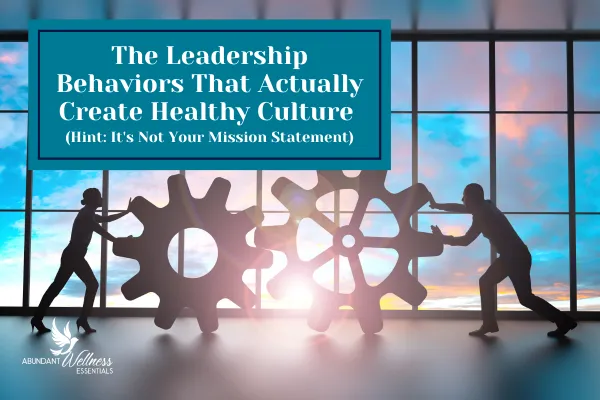
Leadership Behaviors That Build Healthy Culture
The Leadership Behaviors That Actually Create Healthy Culture (Hint: It's Not Your Mission Statement)
Your value statement isn't building your culture. You are, every single day, whether you mean to or not.
Let's tell it like it is: culture isn't created by a poster in the break room or a beautifully worded mission statement on your website. Employees don't learn culture from what's printed on the wall. They learn it from what leadership repeatedly does. Every interaction, every expectation, every decision either strengthens your culture or quietly chips away at it.

The Cultural Capacity Equation, Revisited
If you've followed this series, you know the equation by now: leadership behavior influences culture, culture influences capacity, and capacity influences performance. They're not separate levers, they're one connected system. You cannot fix performance without looking at culture. You cannot fix culture without looking at leadership behavior. It all traces back to the top.
So here's a question worth sitting with this week: What behaviors are being modeled on your leadership team? What gets rewarded? What gets tolerated? And, this one stings a little, what gets quietly ignored?
What I Learned Turning Around a Psychiatric Hospital
I've shared pieces of this story across this series, so here's the piece that ties it together. At this facility, we had high turnover, constant staffing shortages, and leaders trying harder and harder just to keep things afloat. Everyone was laser-focused on hiring, scheduling, and admitting more patients, but that relentless focus on output was quietly wearing the facility down.
What actually turned things around wasn't a new policy. It was consistent leadership. Leaders who could stay calm in the chaos. Leaders who said the same thing today that they'd said last week. Leaders who communicated with clarity people could trust. Once that leadership behavior shifted, the culture shifted with it, staff started investing again because they could finally see hope, and they believed what they were being told.
Here's the principle worth remembering: culture has to change before your metrics change. You can't fix the finances without first fixing the culture underneath them.
What Healthy Culture Actually Looks Like
A healthy culture isn't the absence of stress - stress is part of life, part of work, part of leading. What matters is whether leadership provides stability in the middle of that stress. Healthy cultures share a few consistent traits: psychological safety, clear expectations, real trust, accountability at every level, and consistent communication. Employees feel valued, feel like they matter, and critically, feel heard, even when their suggestions aren't the ones that get implemented.
Four Leadership Behaviors That Strengthen Culture
Clarity. Are your expectations and priorities crystal clear, or is everything treated as equally important -which usually means nothing is?
Consistency. Are your responses predictable, or reactionary? Do you follow through on what you say you'll do?
Recognition. Are you actually pausing to acknowledge effort and celebrate wins, or is that the first thing that disappears when things get busy?
Presence. Are you accessible in the way you've committed to being? Do you truly listen, and can you stay calm when things get hard?
And Four That Quietly Damage It
Treating everything like an emergency. Constantly shifting priorities with no clear rationale. Withholding transparency and leaving employees to fill gaps with assumptions, which, in my experience, is some of the worst advice leaders get. And modeling exhaustion as commitment: never using PTO, never setting boundaries around your own hours, essentially teaching your team that burnout is what dedication looks like. Nobody sets out to build a burnout culture. But it happens through behavior, not intention.
The Sustainable Workforce Method, One More Time
This four-step framework is the same one I used to turn that hospital around: assess where the cultural strain exists, align your systems and expectations, rebuild team cohesion and trust, and equip individuals with sustainable performance skills. That last piece matters, but it's only one piece of four, not the whole solution.
Healthy culture is built intentionally, and it's not HR's job alone. Every leader in the organization owns the culture, because employees are watching how you handle pressure, how you handle conflict, and how you celebrate success. Culture follows leader behavior. Full stop.
If you're ready to look at what's really shaping your organization's culture, not just what's written on the wall, take the Organizational Burnout Assessment to identify your risk factors and get a clear next step forward.

As Seen In


© 2026 Abundant Wellness Essentials. All Rights Reserved.