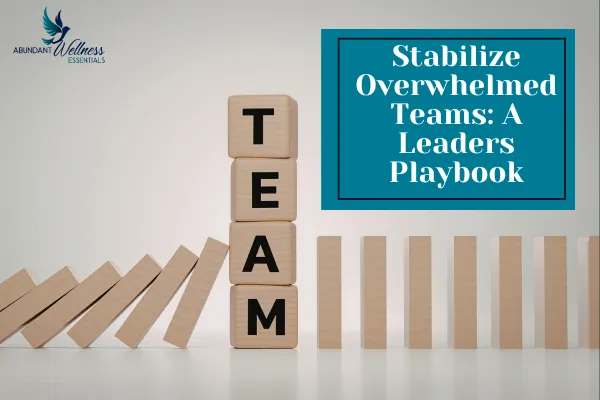
Stabilize Overwhelmed Teams: A Leader's Playbook
How to Stabilize an Overwhelmed Team: The Leadership Clarity Most Workplaces Are Missing
Most teams today are operating in a constant state of overwhelm.
And here's something we have to be honest about as leaders: that overwhelm isn't always coming from work. Your employees are people first, they're carrying family stress, world events, financial pressure, health challenges, and more. Then they walk into a workplace that often piles on more.
The result? Reduced focus. Lost creativity. Collaboration that quietly disappears.
If you missed the first article in this series on how small culture habits create workplace burnout, I'd encourage you to start there. Today we're going one step further: how to recognize an overwhelmed team, and what leadership can actually do to stabilize employee overwhelm.
Spoiler: it starts with leadership clarity and intentional adjustments, not more pressure.
Why Workplace Culture Impacts Employee Health, and Output, So Powerfully
Overwhelm is a system overload. When your employees' internal systems are overloaded, their brains can't produce the way they normally would. They can't think creatively. They can't put coherent sentences together for that proposal. They struggle to collaborate.
You'll see them at their desk, on their computer, looking busy, but very little is actually getting done. That's not laziness. That's chronic stress doing exactly what chronic stress does.
This is why workplace culture impacts employee health so significantly. Long-term stress doesn't just affect mood, it changes brain function, decision-making, productivity, and physical health.
6 Signs Your Team Is Overwhelmed, Most Leaders Miss These
Before you can help employees manage stress, you have to recognize what's happening. Here's what to watch for:
Mistakes and missed deadlines - including from people who never used to miss anything.
Increasing irritability between colleagues - teammates who used to collaborate well now snapping at each other.
Reduced collaboration and disengagement - people hiding in their offices doing solo work because group communication feels like too much.
Looking busy but producing little - bodies at desks, brains overloaded, output declining.
Higher absenteeism - chronic call-outs and vacation use just to survive the week.
Quiet job searching - the unspoken sign. By the time turnover spikes, the small signals were there months ago.
If you're seeing two or three of these, your team is already past the warning lights.
Why Overwhelm Happens and Why It's Often a Leadership Problem
Let's be honest about what creates overwhelmed teams:
Too many competing priorities. If everything is a priority, nothing is. Employees get whiplashed from one "urgent" thing to another with no idea where to actually focus.
Lack of role clarity. Confusion creates chaos. Chaos kills psychological safety.
Continuous changes without adjustment time. People can adapt, but not when expectations shift daily.
Unintentional pressure pushed downhill. Leaders absorb pressure from above and pass it down. I get it. I've done it. But middle management especially has to learn to push back uphill, not just nod and pile it on the team.
What Overwhelmed Teams Need from Leadership Right Now
Here's the good news: small, sustainable shifts can stabilize employee overwhelm faster than any massive reorganization. To help employees thrive, start here:
1. Get crystal clear on priorities. You, the leader, decide the order. Then communicate the why because when people understand why, buy-in skyrockets and output follows.
2. Reduce unnecessary tasks. Ask "Why does this need to be done? Does it need to be done now?" Looking busy is not the same as being productive.
3. Protect focus time. If your employee has an hour blocked to work on a project, protect it. Don't schedule a meeting in it. Don't walk in with 20 questions. Let them work.
4. Communicate transparently, even when things are uncertain. "We have changes coming. I don't have all the details yet, but keep doing what you're doing and I'll come back when I know more." That sentence builds more culture than any leadership retreat.
5. Be a present, supportive leader. Whether you're in the office or remote, your support has to feel consistent. Open office hours. Texts answered. Voices heard.
How to Stabilize Teams for the Long Term
Quick fixes won't hold. Sustainable culture systems will. To create a positive workplace culture and prevent high-achiever burnout, build these in:
Predictable work rhythms. Same day, same time, same place for recurring meetings. Predictability is psychological safety.
Crystal clear roles and responsibilities. Every employee should know their lane and who to direct it to when something falls outside it.
Open communication about workload. When someone says "I can't take on more," do you problem-solve together or say "your problem"? One builds trust. The other builds turnover.
Normalize rest and recovery. This is the hardest one. Even during deadline crunches, where is the lunch break? The 15-minute walk? The recovery time after the project ends? When we push through, errors multiply. When we step away, focus returns.
When Team Overwhelm Signals a Bigger Problem
Here's what I want you to hear: team overwhelm often signals a deeper systemic burnout risk in your organization. And cultural problems show up long before most leaders notice them.
That's why I created a free Burnout Assessment specifically for organizations. It helps you identify exactly where stress patterns are impacting your team's performance, so you can make small, intentional adjustments before workplace burnout costs you your best people.
Because I want your teams to thrive. And I know you do too. 💛