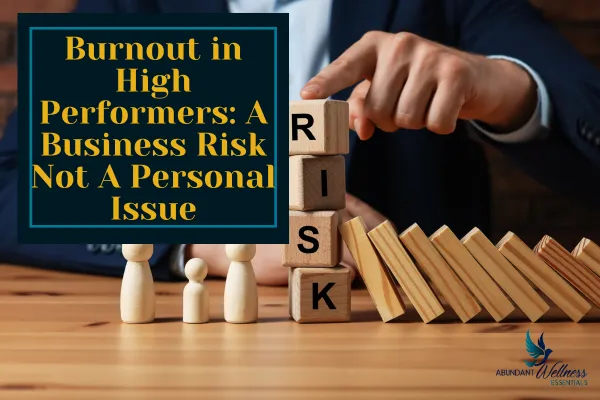
Burnout in High Performers: A Business Risk Not Personal Issue
Business Risk, Not a Personal Issue

Burnout is a Business Risk, Not a Personal Issue: What Leaders Need to Know
When performance metrics drop, retention falters, and your company culture starts to decay, burnout isn't just affecting employee wellbeing, it's directly impacting your bottom line. Yet most organizations continue to frame burnout as a resilience problem, treating it as an individual weakness rather than what it truly is: an organizational system failure.
The Hidden Cost of Organizational Wellness Failures
If you're a leader watching productivity, retention, and culture suffer, burnout is already affecting your profit and loss statement. This isn't a wellness perk discussion, it's a risk management conversation that demands immediate attention.
The challenge? Wellness perks help, but they don't solve the bigger problem. They merely mask symptoms until burnout disappears from your dashboard. Meanwhile, burnout hides behind productivity and compliance, creating the illusion of good output while cognitive, emotional, and relational capacity slowly erodes internally.
Early Warning Signs of Employee Burnout
Being aware of early burnout signs is imperative to preventing major financial impact. Leadership and burnout intersect when you start noticing:
Disengagement from previously motivated team members
Increased errors in routine tasks
Irritability and shortened tempers
Rising turnover intent
Employees who simply no longer care
I've witnessed this firsthand as a supervisor. Professionals with dedicated documentation time would leave early rather than completing their work. When questioned, they'd say, "I just needed a break this week. I'll use the time next week." Week after week, they fell further behind. By the time metrics shifted noticeably, the damage was already done.
The Real Financial Impact of Burnout in High Performers
The cost to organizations is often underestimated and sometimes irreplaceable. Consider these factors:
Replacement Costs: For every employee you replace, you're spending at least 1.5 times their salary on recruitment and training just to get someone up to speed.
Leadership Bandwidth: Leaders must invest time overseeing struggling employees, problem-solving, and managing potential write-ups or terminations; all increasing turnover and recruitment expenses.
Presenteeism: People physically present at work but not fully functioning. Their output has declined even though they're visible.
Medical Claims: As a licensed mental health professional, I've seen requests for medical or disability leave documentation increase tenfold in the last six years compared to my previous 16 years of practice. Organizations face rising insurance premiums, uncertain disability leave durations, and frequent absenteeism from employees calling out sick.
Culture Decay: High performers leave first. When your people become cynical about work, burnout has infected the entire organization, and it could have been prevented.
Custom HTML/CSS/JAVASCRIPT
Why Burnout Becomes Persistent in High-Performing Cultures
Burnout thrives in environments where over functioning is rewarded, not regulated. When high performers are praised for staying late every time they're asked instead of protecting recovery time, exhaustion becomes the norm.
In these exhausted cultures, everything becomes urgent. This urgency transforms into the organization's identity, causing systems to rely on heroics instead of sustainability when stability should be the standard.
This manifests when leaders normalize stress with phrases like:
"This is just how it is"
"Get used to it"
"Find a way to deal with it"
Instead of redesigning workflows and systems, leaders inadvertently create environments where employees no longer feel safe and supported. This constant pressure erodes psychological safety, and no one should be expected to work under unrelenting pressure.
Enterprise Risk Categories Triggered by Organizational Burnout
This culture shift triggers specific risk categories:
Operational Reliability: What used to work becomes ineffective
Talent Retention: Organizational reputation suffers as word spreads
Leadership Pipeline Overload: Leaders who excel at team development and solution creation become perpetual firefighters
Organizational Resilience: Impossible to achieve when you're constantly putting out fires Increased Error Rates: Burnout drives decision fatigue and mistakes
Real Solutions: How Organizations Reduce Burnout Effectively
Risk mitigation requires systems change, not perks. Wellness without structural reform is just theater, a smoke show that signals leaders don't truly care.
1. Treat Workloads as a Design Issue, Not an Endurance Test
Build systems that help employees succeed. Measure capacity, not just output.
Consider two employees with identical output: one takes 50 hours to complete tasks while another finishes in 30 hours. The 50-hour employee experiences exhaustion, brain fog, and decision-making struggles. As a leader, it's tempting to ask both for more based on their output. Instead, explore their capacity. What is the 30-hour employee doing that increases efficiency while maintaining quality?
2. Train Leaders in Nervous System Literacy and Stress Recovery
Leaders should model healthy, effective ways to regulate their nervous system and stress response. Employees follow leaders who implement what they teach.
3. Build Recovery Into Workflows, Not Just After Hours
The human brain isn't designed for constant task-switching eight hours daily without built-in recovery time. Workflows incorporating recovery lead to higher output and quality work as employees become more efficient.
4. Normalize Sustainability as a Performance Standard
Teams that remain stable for years become operational machines with everyone contributing their part effectively. Sustainability should be valued as highly as productivity.
Moving Forward: From Burnout to Breakthrough
Burnout isn't a personal weakness—it's an organizational liability. Everyone in the organization needs to take responsibility for change. When ignored, burnout erodes performance instead of preserving it.
Remember: Culture isn't what you say, it's what your system allows and how you lead by example. Employee burnout prevention starts with leadership decisions made today.
Want to assess how burnout is affecting your organization? Take the organizational burnout quiz at https://burnoutbasics.com/orgquiz to gain insight into what's really happening within your teams.