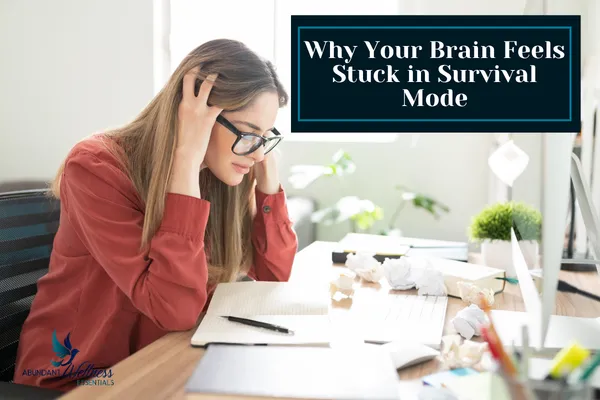
Why Your Brain Feels Stuck in Survival Mode
Why Your Brain Feels Stuck in Survival Mode and Why That's Not a Character Flaw
Have you ever walked into a room and forgotten why you were there? Read the same email three times? Felt overwhelmed by a decision that used to feel simple?
Most people assume those moments mean they're failing. They're not. Those are signs that your brain is doing exactly what it was designed to do under chronic stress. Your brain is not malfunctioning. It is prioritizing survival.
Your Brain Doesn't Know the Difference
Your brain and body are designed to prioritize survival the moment they sense a threat, whether that threat is real or only perceived. When stress becomes chronic, your nervous system stays elevated and believes you are in a crisis, whether you actually are or not. Your brain does not know the difference between a charging bear, a toxic work environment, chronic overload, or constant uncertainty. It just responds the same way every time.
When that happens, your brain stops the long term thinking process in favor of short term protection. Your frontal lobe, the part responsible for decisions, planning, problem solving, and emotional regulation, is not fully online. Instead, your brain stem takes over, asking one question on repeat. Do I run? Do I fight? Or do I freeze?
What This Looked Like for Me
In an earlier post, The Burnout Cycle Nobody Talks About, I shared a little about my third burnout episode. I want to expand on that here, because that season was one where I could not see clearly anymore. I could not see past what felt like a crisis every time I walked out of my house, or every time I thought about going back to work. I was constantly overwhelmed. I was forgetting things that mattered. Focusing was incredibly difficult, and I became emotionally reactive to the point that I cussed at my boss one day and did not care.
If any of that sounds familiar, I want you to know there is a way through it. I asked myself the same question hundreds of my clients have asked me. Why can't I keep up this pace anymore? I used to handle so much more than this. What is wrong with me? Here is the honest answer. Nothing is wrong with you. Your nervous system is overloaded, the same way mine was. It took my doctor, and later a colleague, to help me finally see what recovery could look like.
What Chronic Stress Does to Your Brain
When your prefrontal cortex loses function, decision making gets harder. Creativity shuts down, because creativity is not pertinent to survival. Many people describe this as brain fog. Your thoughts feel muddled. Poor concentration shows up next. That report that used to take twenty minutes now takes an hour. Decision fatigue often shows up around food specifically. I know because I lived it, and I have seen it happen a hundred times over with clients. You stop asking what you want to cook and just default to fast food.
At the same time, your amygdala, the emotional center of the brain, becomes more reactive. That means you detect threats faster, but it also means you are more likely to lash out verbally instead of staying calm. Anxiety increases because you are constantly on alert, wondering what is coming next. Irritability shows up more easily. This is hypervigilance, and your brain is excellent at getting you through survival. What it cannot do while in that state is help you thrive.
High Achievers Miss Their Own Signs
I see this constantly, and I lived it myself. High performers tend to push harder when they hit these symptoms, telling themselves that if they just get through this one project, things will calm down. In reality, pushing harder only works temporarily. When I finally healed my identity and changed how I approached work, I started working fewer hours and getting more done. When I pushed harder instead, I got less done. It sounds backwards, but I have watched it prove true again and again.
This is the sustainable performance gap™ I talk about often. Performance stays high while capacity quietly declines underneath it. Success can hide burnout for a long time. What looks like success from the outside might already be burnout doing damage on the inside.
How Survival Mode Changes Leadership and Home Life
Leaders are human too. When the frontal cortex is not functioning optimally, strategic thinking suffers, patience runs short, and reactivity increases. If a leader is burnt out, that trickles down to the team through more conflict, less collaboration, and more isolation. People retreat to their own offices instead of coming together, because collaboration has started to feel like conflict.
The effects follow you home as well. You might physically be present with your family while mentally checked out. Patience runs thinner. You might withdraw into your own space instead of joining in. None of this is a character flaw. It is your nervous system responding to what is happening around it. It does not speak to who you are as a person.
Recovery Begins With Safety
Recovery starts the moment your brain experiences safety again. That is the foundation of my SPARK Method™. First, recognize whether you are actually in survival mode and identify the root causes behind it. For me, that meant recognizing I had let go of my morning routine because I thought it would buy me more sleep. It did not work.
From there, identify your environmental triggers. If leadership treats everything as urgent, that is a trigger worth naming. Once triggers are identified, small recovery strategies come next, along with reinforcing healthy systems. Protecting sleep matters more than almost anything else, because your brain and body recover and detox while you sleep. Boundaries matter too, even though they are hard to set. None of this is about working harder. It is about helping your brain feel safe again.
If you recognize yourself as overwhelmed, forgetful, exhausted, or emotionally reactive, please do not assume you are failing. Take the Professional Burnout Assessment to identify your burnout risk level and get practical next steps toward recovery.