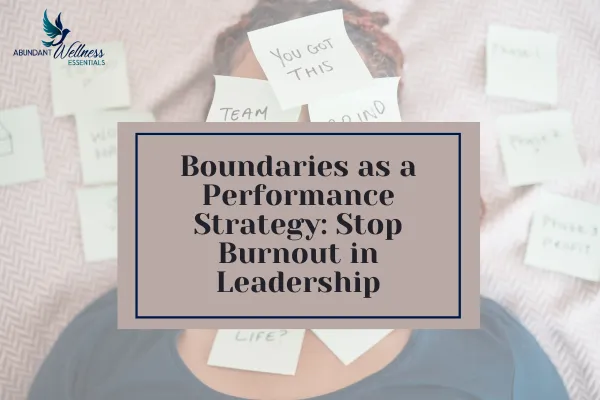
Boundaries as Performance Strategy: Stop Burnout in Leadership
Boundaries as Performance Strategy: Stop Burnout in Leadership

Why Boundaries Are Your Secret Performance Strategy, Not a Sign of Weakness
If you're a high performer or leader struggling with the word "boundaries," you're not alone. Most people think boundaries are about saying no, being unavailable, or somehow failing to be the reliable team player everyone expects.
But here's the truth: boundaries aren't about limitation, they're about optimization.
The Hidden Cost of Boundary Free Performance
High performers resist boundaries not because they're weak, but because they're deeply committed. There's an innate desire to be seen as reliable, and somewhere along the way, we've conflated availability with value.
But unprotected commitment leads directly to burnout in leadership and among high performers. Without boundaries, you'll experience:
Cognitive fatigue where the email that used to take 5 minutes now takes 20.
Attention fragmentation by Losing sight of critical details that matter to your work.
Compromised recovery time when personal downtime is consumed by catching up on work.
Silent resentment when you feel like just another cog in the wheel.
Performance decline which inevitably affects long-term output.
The symptoms show up as brain fog, decision fatigue, exhaustion, and difficulty focusing. And when you're not protecting your time to complete committed tasks, excellence becomes impossible.
Why High Performers Struggle With Boundaries
The struggle is real, and it's rooted in some powerful beliefs.
Reliability becomes an unspoken contract. The more people see you as reliable, the more they ask of you. Saying yes feels like responsibility and team membership. Saying no feels risky, even like you might lose your job.
But here's what's actually happening: You're absorbing inefficiencies. You're over functioning, which might seem like it earns rewards but ultimately becomes a punishment when your body collapses from burnout.
The Common Myths About Boundaries
Myth #1: Boundaries keep you stuck. This myth exists because boundaries are often framed as emotional self-care only. But boundaries without strategy creates guilt and inconsistency.
Myth #2: Boundaries make you less reliable. Actually, boundaries help people know what to expect from you. You gain consistency because the goal isn't to withdraw, it's to be sustainable.
The Truth: Strategic boundaries protect your focus, energy, and decision quality. They make you more effective, more present, and yes, more reliable.
How to Create Boundaries That Protect Performance
1. Clarify Your Role.What's yours to manage, and what belongs to others? As a leader or high performer, you can't take it all on yourself.
2. Protect Deep Work Time. Time boundaries aren't just about meetings. Protect the time you need for focused, detailed work that moves important projects forward.
3. Set Emotional Boundaries. These prevent you from absorbing unnecessary stress. If you don't have bandwidth to listen and absorb what someone wants to share, that moment isn't the right time. This isn't callousness, it's protecting your capacity to function and succeed.
4. Define True Availability. Challenge the urgency culture. What really constitutes an emergency? Most things aren't urgent. Every ping from a messaging app or email doesn't require immediate response. Separate genuine emergencies from manufactured urgency driven by anxiety.
Boundaries Are a System, Not Willpower
Think of boundaries as part of your performance system, not a test of discipline. When boundaries fail, your nervous system loses support. Exhausted systems can't enforce boundaries, creating a vicious cycle.
You'll default to old patterns under stress. That's why boundaries need to become habits and new routines, practiced consistently until they replace those old defaults.
Remember: Boundaries are a capacity issue, not a discipline issue.
The Path Forward
Burnout in leadership and among high performers isn't inevitable. It's the result of functioning boundary free for too long.
When you design boundaries that align with your values and capacity, you:
Sustain your energy
Lead without self-sacrifice
Do what matters well
Protect your performance excellence
Boundaries don't limit high performers, they protect them.
This isn't about doing less. It's about doing what matters and doing it with excellence. Because excellence requires structure, not self-abandonment.
Ready to reclaim your energy and performance? Start with my free guide, Stress to Peace, which walks you through 3 easy steps to reduce stress, maintain energy, and set boundaries that actually stick.